
From Zhouyi To Book Of Changes
The core text is often associated with the Zhouyi, an early divination classic connected with the Zhou cultural world. Over time, layers of commentary turned it into a philosophical book about change, timing, conduct, and relation.
This layered history matters. The Yi Ching is not only a method for asking questions. It is also a library of images, judgments, and ethical reflections built across generations.
Hexagrams And Lines
The book is organized around sixty-four hexagrams. Each hexagram has six lines, made from Yin broken lines and Yang solid lines. The lines create a picture of a situation in motion.
A hexagram can be studied as a whole image, as two trigrams, and as a sequence of changing lines. This gives the reader several levels of reflection: condition, tension, timing, and possible transformation.
Judgment, Image, And Timing
Yi Ching language is compact. A short phrase may point to danger, restraint, advance, retreat, waiting, gathering, or renewal. The reader must slow down and ask how the image fits the real situation.
The most useful question is often not "What will happen?" but "What kind of moment is this, and what response would be appropriate?"
A Responsible Modern Approach
Modern readers can use the Yi Ching as a reflective practice. It can support journaling, decision review, seasonal reflection, and pattern recognition.
It should not replace professional advice, personal responsibility, or practical evidence. Its strength is attention: it slows the mind before action.
How It Can Fit The Site
Later, Yi Ching-inspired pages can become seasonal prompts, decision journals, and reflective mini reports. The first step is teaching the language clearly and responsibly.
For beginners, we start with Yin-Yang, the Five Elements, and the Eight Trigrams so the Yi Ching feels less like a mysterious text and more like a structured language of change.
A useful modern reading should leave a person more attentive, not more dependent. If the practice creates fear, urgency, or blind obedience, it has moved away from the reflective spirit we want here.
Before reading a hexagram, follow this order.
Many Western readers first meet the Yi Ching as a mysterious oracle. Eastern Elements keeps that history visible while using hexagrams as careful images of change, timing, and conduct. This path gives a new visitor a safer sequence: boundary, symbols, then practice.
Is the Yi Ching fortune telling?
Name the oracle history honestly, then learn why Eastern Elements avoids fixed-fate prediction and guaranteed outcomes.
Read the answerSymbol systemHow do hexagrams become useful?
Start with Yin-Yang lines, the Eight Trigrams, and a few example hexagrams before trying to interpret everything at once.
Study the trigramsPractical methodHow do I ask a useful question?
Use a clear question, notice the changing lines, and end with one grounded next step instead of asking for a verdict.
Use the reflection methodA reading should make the next step cleaner.
The Yi Ching becomes useful when it changes the quality of attention before action. It should not create fear, urgency, dependence, or a feeling that judgment has been outsourced.
Clear the question
Ask what is changing, what kind of moment this is, and what response would fit.
Read the image
Treat the hexagram as a compact picture of timing, tension, conduct, or relation.
Choose one action
End with one modest next step instead of turning the reading into a verdict.
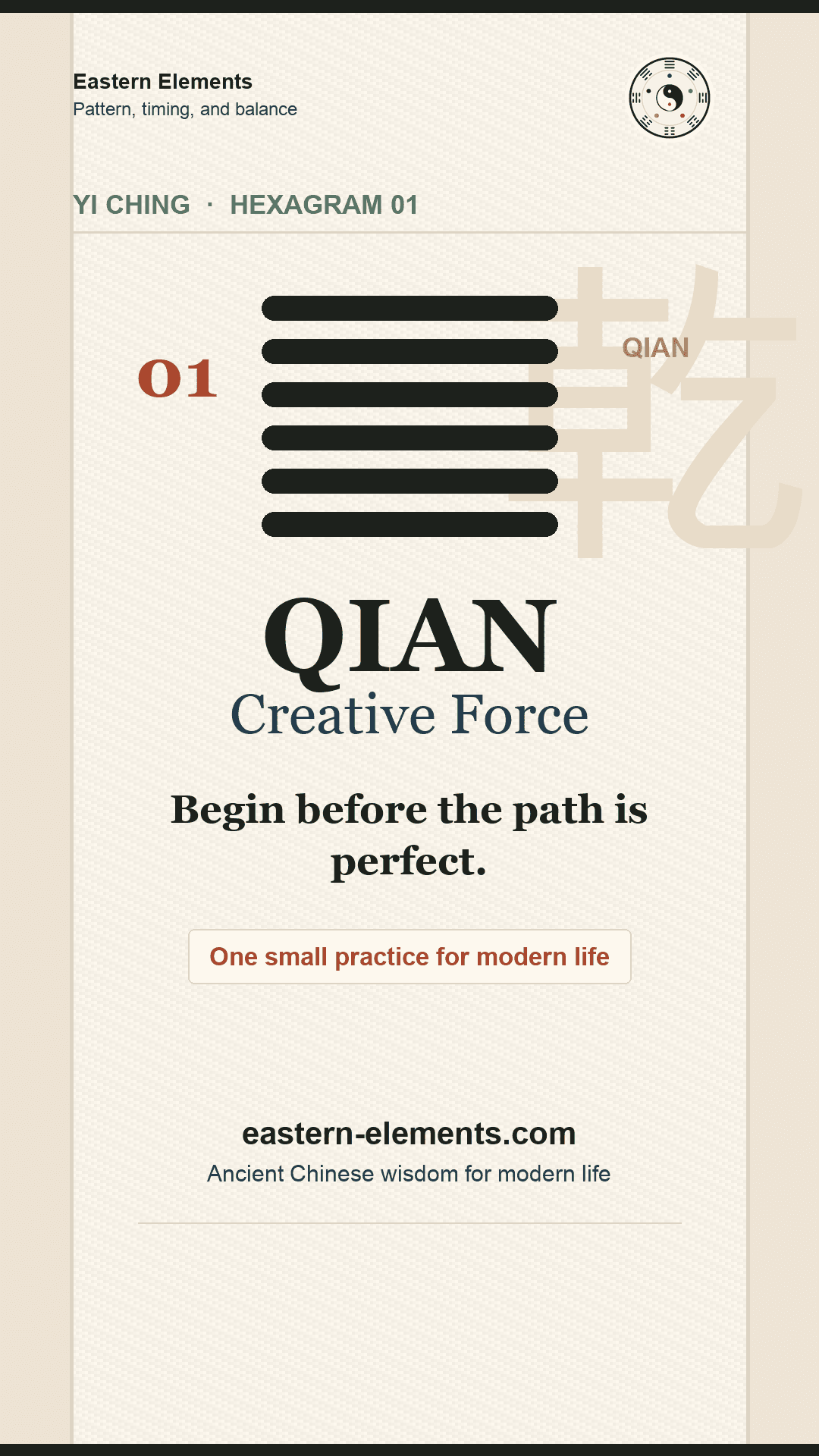
Start with the first six hexagram reflections
Each page pairs a short video with notes, a transcript, journal prompts, and one small practice. This first set keeps the series compact while we watch for real reading and traffic signals.
Continue through the closest related questions.
These links connect the foundation article to the next search-friendly pages, so a new reader can move from definition to comparison, responsible use, and a practical first step.
Read the overview with its anchors visible.
This page is a beginner doorway, so it keeps the deeper sources close: external scholarly references, the site source map, and related internal paths.
Everyday example
Before a career decision, a Yi Ching-inspired practice might begin with three written questions: what is changing, what is fixed, and what timing does the situation seem to ask for? This turns anxiety into observation.
The value is not in outsourcing the decision. The value is in slowing down enough to notice pressure, readiness, risk, restraint, and the kind of conduct that would still feel honorable after the result is known.
Terms to keep close
Change
The core subject is movement: conditions arise, peak, transform, and pass.
Timing
A wise response depends on the season of the situation, not only on willpower.
Image
Natural images help the reader think beyond flat categories.
Line
Lines show position, relation, and movement inside a changing situation.
Conduct
The classic repeatedly asks how a person should act with care and restraint.
Historical notes
The Zhouyi is generally treated as the early core of the tradition, rooted in ancient divination and political-ritual culture.
Later commentaries, including the tradition known as the Ten Wings, expanded the book into cosmology, ethics, and philosophy.
The Yi Ching has been translated and read widely outside China, often as a book of reflection, symbolism, and decision-making.
Common beginner questions
What is the Yi Ching in simple terms?
The Yi Ching is the Book of Changes, a classical Chinese text organized around sixty-four hexagrams. It uses line symbols, images, and short statements to reflect on changing situations.
Is Yi Ching the same as I Ching?
Yes. Yi Ching is the spelling Eastern Elements uses for visible copy. I Ching is the older spelling many English readers know. Both point to the Chinese Book of Changes.
Is the Yi Ching fortune telling?
The Yi Ching has an oracle and divination history, but Eastern Elements does not use it as fixed-fate prediction. The site reads it as reflective pattern language for timing, conduct, and careful attention.
What are hexagrams?
Hexagrams are six-line figures made from broken Yin lines and solid Yang lines. Each hexagram can be read as an image of a situation and as two trigrams in relationship.
How should a beginner use the Yi Ching?
Begin with one concrete question rather than a demand for certainty. Learn the basic Yin-Yang and trigram language, notice whether a line is changing, then record one fitting response. Our practical reflection guide shows the sequence step by step.